Choose Search ads when you want tight control over which keywords trigger your ads. Choose Performance Max (PMax) when you have clear conversion goals, solid tracking and good creative, and you want Google’s AI to find customers across all of its channels. Many Canadian businesses do best running both, with Search covering their most important keywords.
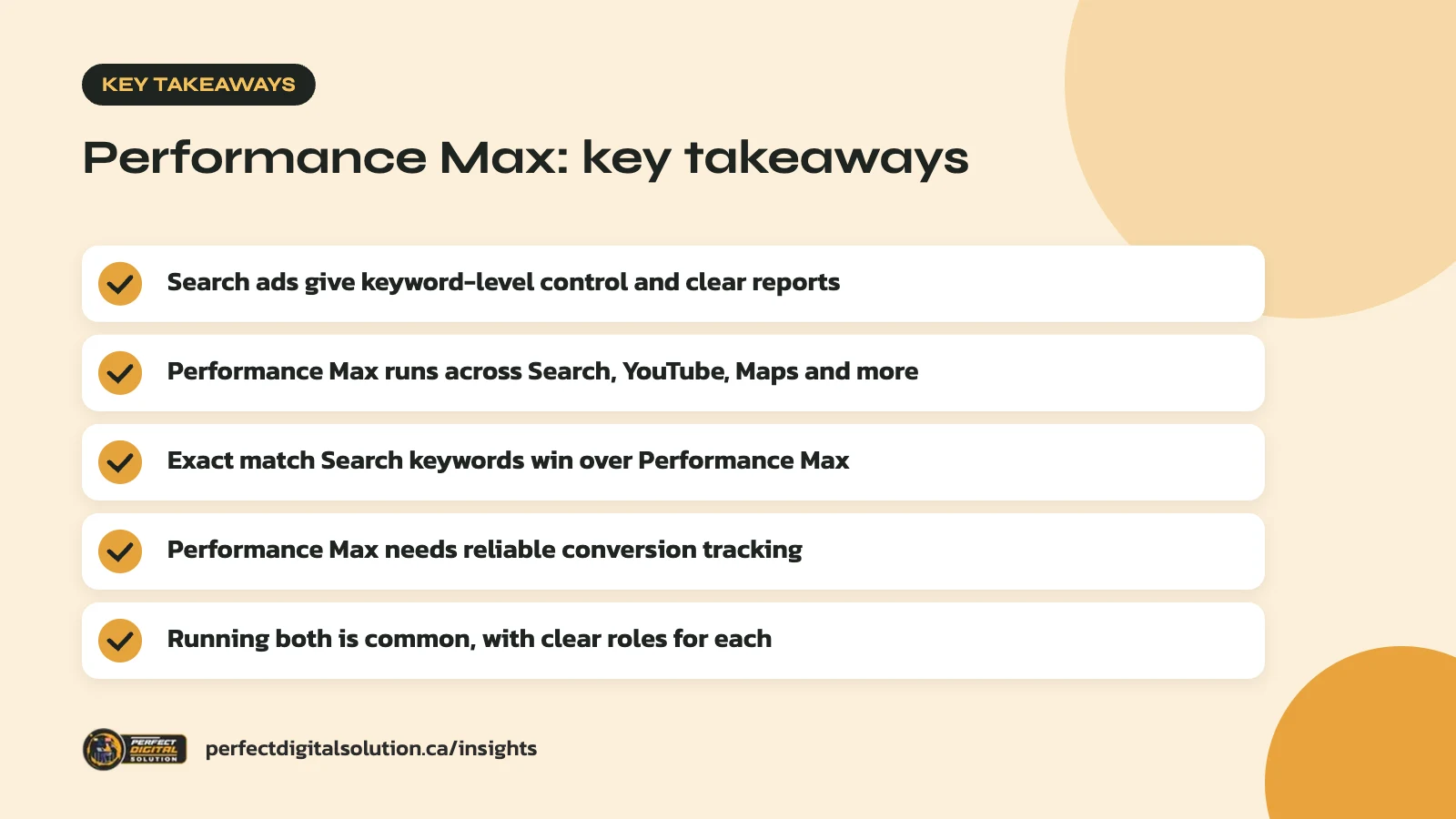
Key takeaways
- Search ads give you keyword-level control and clear reporting.
- Performance Max runs across Search, YouTube, Display, Maps and more.
- Exact match Search keywords take priority over PMax.
- PMax needs reliable conversion tracking to work well.
- Running both together is common, with clear roles for each.
Search ads vs Performance Max at a glance
Search campaigns show text ads on Google search results for keywords you pick, while Performance Max is a goal-based campaign that can reach all Google Ads inventory from one campaign.
Here is a quick side-by-side view:
| Feature | Search campaigns | Performance Max |
|---|---|---|
| Where ads show | Google search results (and optionally search partners) | Search, YouTube, Display, Discover, Gmail and Maps |
| Targeting | Keywords and match types you choose | Google AI, guided by your goals, assets, audience signals and search themes |
| Ad formats | Text ads | Text, image, video and, for retailers, product ads from a feed |
| Control | High | Lower, with a growing set of controls |
| Best for | High-intent keywords and tight budgets | Broad reach toward clear conversion goals |
Neither type is always better. The right choice depends on your goals, your tracking and how much control you need. It also depends on what you sell. A local service business and a national online store often need very different setups, even with similar budgets.
How Search campaigns work
Search campaigns match your ads to what people type into Google, based on the keywords you choose.
You control reach with keyword match types. Google’s keyword matching options guide explains the three types:
- Broad match can show ads on related searches. It is the default and reaches the most people.
- Phrase match shows ads on searches that include the meaning of your keyword.
- Exact match shows ads on searches with the same meaning or intent, and gives you the most control.
Negative keywords stop your ads from showing on searches you do not want, such as “free” or “jobs”. You write the headlines and descriptions and choose the landing page for each ad group.
The big strength is clarity. You can see which search terms led to clicks and conversions, then adjust bids, keywords and ads directly.
How Performance Max works
Performance Max combines your goals, budget and creative assets with Google’s AI to show ads wherever it predicts a conversion is likely.
According to Google’s Performance Max overview, one campaign can reach YouTube, Display, Search, Discover, Gmail and Maps. Instead of keywords, you give the system a few key inputs.
Conversion goals and bidding
You choose which conversions matter, such as purchases or lead forms. Smart Bidding then sets bids in each auction based on how likely a conversion is. You can add a target cost per acquisition or target return on ad spend.
Asset groups
Asset groups are sets of headlines, descriptions, images, logos and videos built around a theme or audience. Google mixes and matches them into ads for each placement. Retailers can also connect a product feed.
Audience signals and search themes
Audience signals, such as your customer lists or website visitors, help the campaign learn faster. Search themes tell Google which kinds of searches are valuable to you, without acting as strict keywords.
Final URL expansion
If this setting is on, Google can send people to a more relevant page on your site and create matching headlines. You stay responsible for what those pages say, so exclude pages that should never receive ad traffic.
How Search and Performance Max work together
When both campaigns could show an ad for the same search, a Search campaign with a matching exact match keyword takes priority over Performance Max.
Google also states that PMax search themes have the same priority as phrase and broad match keywords. In practice, this means your most important terms should sit as exact match keywords in a Search campaign if you want full control over them.
Brand exclusions are another useful tool. They can stop Performance Max from showing on searches for your own brand name, so brand traffic stays in a Search campaign where you can see and manage it. This avoids paying for clicks that might have come through anyway.
In our account reviews we often see PMax claiming credit for brand searches and returning customers. Separating brand traffic makes it easier to see what each campaign really adds.
When Search ads are the better choice
Search ads usually make more sense when control and clear intent matter more than reach.
- Your budget is small and you need every click to count.
- You sell a service where intent is obvious from the search, such as “emergency plumber Calgary”.
- You do not have strong images or video yet.
- Your conversion tracking is new or not fully trusted.
- You work in a regulated field where you need to approve every message and landing page.
- You want to test new keywords or offers and read the results quickly.
Search campaigns also make a strong starting point. The data they produce about which terms convert can guide your later PMax setup.
When Performance Max is the better choice
Performance Max fits best when you have a clear, measurable goal and want to reach customers beyond the search results page.
- You run an online store with a well-managed product feed.
- You track sales or leads accurately, ideally with conversion values.
- You have good images, logos and ideally short videos.
- You want reach on YouTube, Gmail, Maps and Display without managing separate campaigns.
- You have enough conversion volume for the system to learn from.
For e-commerce brands, PMax often replaces Standard Shopping as the main product campaign. For lead generation, results depend heavily on lead quality, so feed back which leads became customers when you can.
What you need before launching Performance Max
Strong conversion tracking is the most important requirement, because the campaign optimizes toward whatever you tell it counts as a conversion.
- Accurate conversions. Count real outcomes, such as purchases or qualified leads, not page views. Our guide to Google Ads conversion tracking with GA4 walks through the setup.
- Quality assets. Prepare several headlines, descriptions, images in different shapes, your logo and, if possible, a short video.
- A clean feed (for retailers). Accurate titles, prices and stock levels help product ads.
- Exclusions. Add brand exclusions, negative keywords and URL exclusions before launch.
- Patience. Give the campaign time to learn before making big changes.
Budget depends on your goals, your market and how competitive your industry is. Ask whether your budget can produce enough conversions for the system to learn, rather than picking a number at random.
Controls and reporting in Performance Max
Performance Max now offers much more visibility than it did at launch, though still less than a Search campaign.
Google’s PMax visibility and control update describes several tools now available to advertisers:
- Campaign-level negative keywords that apply to Search and Shopping inventory.
- A search terms report for all PMax campaigns.
- Channel performance reporting that shows where ads ran.
- Full asset reporting, including conversions and cost by asset.
- Device targeting and age-based controls.
These tools close some of the gap with Search campaigns, but they do not give you the same keyword-by-keyword control. Treat them as guardrails rather than full steering.
Check these reports regularly. Remove weak assets, add negatives for irrelevant searches and compare results against your Search campaigns. If you are still deciding between paid and organic, our SEO vs Google Ads guide can help, and your 2026 digital marketing plan should set the role of each channel.
How Perfect Digital Solution can help
Our Google Ads management team sets up Search and Performance Max campaigns with clean tracking and clear roles for each. If you want a second opinion on your current account, get in touch and we will review it with you.
Related reading: Black Friday Readiness: Prepare Your Online Store and Google Ads Before November. · Google Ads location targeting in Calgary
Frequently asked questions
Sources
- About Performance Max campaigns (Google Ads Help)
- Unlock more visibility and control in Performance Max (Google Ads Help)
- About keyword matching options (Google Ads Help)
Written by the Perfect Digital Solution team. We use AI tools to support research and drafting, and every fact in this article is checked by our team against the sources listed above.