Helpful content is content written first for people, based on real knowledge, that fully answers what the reader came for. Google’s systems are built to reward it, and the same qualities make it more likely to be used in AI search features. This guide explains what helpful content means, how E-E-A-T fits in and how to apply both to your business blog.
Key takeaways
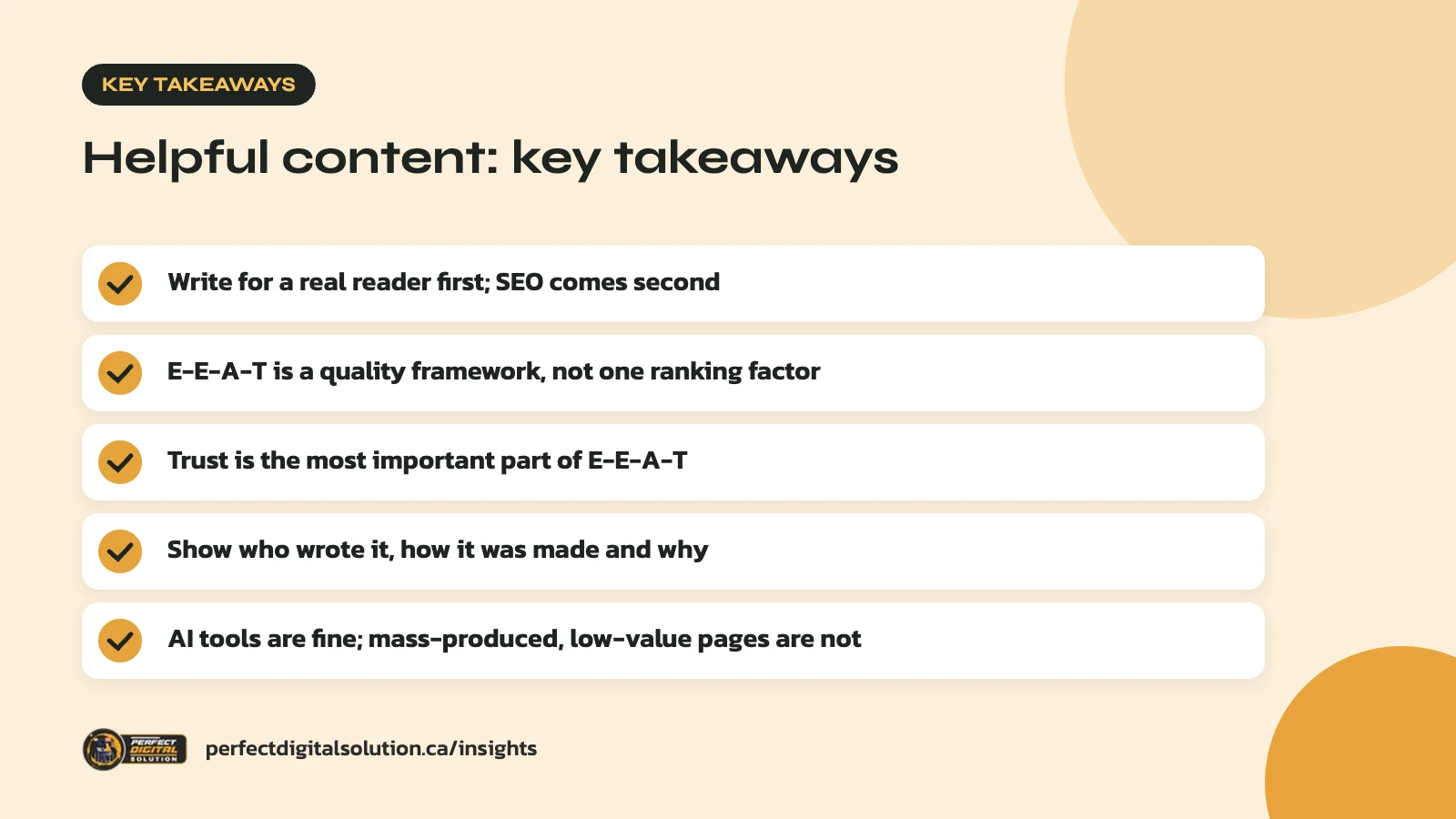
- Write for a real reader first; SEO comes second, not instead.
- E-E-A-T is a quality framework, not a single ranking factor.
- Trust is the most important part of E-E-A-T.
- Show who wrote it, how it was made and why it exists.
- AI tools are fine; mass-produced, low-value pages are not.
What Google means by helpful content
Google describes helpful content as reliable, people-first content that would still be useful if the reader arrived directly at your site, not through search. Its guide to creating helpful, reliable, people-first content says its ranking systems aim to put this kind of content first.
People-first does not mean ignoring SEO. Google says SEO is fine when it is applied to content made for people. Clear titles, good structure and fast pages help readers and search engines at the same time. The problem starts when search traffic becomes the main reason a page exists.
A simple test: would a customer who found this page through a friend’s link feel they learned something useful? If the honest answer is no, the page probably needs more than a keyword tweak.
E-E-A-T explained in plain language
E-E-A-T stands for Experience, Expertise, Authoritativeness and Trustworthiness, and it describes what makes content worth relying on. Google added the extra “E” for Experience to its search quality rater guidelines in December 2022.
| Letter | What it means | How to show it |
|---|---|---|
| Experience | First-hand use of the product, place or process | Real photos, specific details, lessons learned |
| Expertise | Knowledge and skill in the topic | Author background, accurate detail, correct terms explained |
| Authoritativeness | Being a known, go-to source | Mentions and links from respected sites, a consistent topic focus |
| Trustworthiness | Accuracy, honesty and safety | Sources, clear contact details, up-to-date facts, no misleading claims |
Three things people often get wrong
- It is not one ranking factor. Google states that “E-E-A-T itself isn’t a specific ranking factor.” Its systems use a mix of signals that tend to line up with good E-E-A-T.
- Trust matters most. Google says trust is the most important part, and the other three support it. A page does not need to show all four to be helpful.
- Some topics need more. Pages about health, money, safety or society’s well-being, often called “Your Money or Your Life” topics, get extra weight on strong E-E-A-T.
Quality raters do not decide your rankings either. Google says rater data is not used directly in its ranking algorithms. Raters help Google check whether its systems are working as intended.
Warning signs your content is written for search engines first
Search-engine-first content usually shows itself through intent: it was made to catch traffic rather than to help someone. Google lists several warning signs in its helpful content guidance.
- Writing about topics only because they seem to be trending, with no real knowledge behind them.
- Publishing lots of content on many unrelated topics in the hope that some of it ranks.
- Summarizing what other pages say without adding anything new.
- Leaving readers feeling they need to search again to get a proper answer.
- Changing the date on a page to look fresh without changing anything meaningful.
In our content audits, the most common issue we find is not bad writing. It is pages that repeat the same generic advice as every competitor, with nothing that shows the business has actually done the work.
Who, How and Why: three questions to ask about every page
Google suggests judging content by who created it, how it was made and why it exists, and the “why” is the most important of the three.
Who created it
Make it clear who is behind the content. Bylines and short author bios help readers judge credibility, especially on advice-style posts. Google warns that fake author profiles are a form of deception, so only use real people.
How it was made
Explain how you reached your conclusions when readers might wonder. For a product review, that could mean saying how you tested it. If AI or automation played a large role, tell readers where they would reasonably expect to know.
Why it exists
The main reason for a page should be to help people. If a post exists only because a keyword tool showed search volume, rethink the angle until it serves a real customer question.
Why helpful content matters for AI search too
People-first content is also the foundation for showing up in AI search features, because Google says the same SEO fundamentals apply. Its page on AI features and your website states there are no extra requirements or special optimizations needed to appear in AI Overviews or AI Mode.
To be eligible, a page must be indexed and able to show in Google Search with a snippet. Google also recommends keeping important content in text, supporting it with relevant images and video, and making sure any structured data matches what is visible on the page. Traffic from these AI features is counted in Search Console’s Performance report under the “Web” search type.
Our guides to generative engine optimization and checking your AI search visibility go deeper into how AI tools choose which businesses to mention.
How to use AI writing tools without hurting trust
Using AI to help write content is not against Google’s rules, but publishing large amounts of low-value AI text is. The difference is human effort, accuracy and original input.
Google’s spam policies define scaled content abuse as creating many pages mainly to manipulate rankings rather than help users, “no matter how it’s created.” Using generative AI to produce many pages without adding value is one of the listed examples.
- Use AI for outlines, first drafts or rewording, not for facts you have not checked.
- Add what only your business knows: local details, real processes, common customer mistakes.
- Have a person with real knowledge review and edit every post before it goes live.
- Check every number, date and claim against a reliable source.
A practical checklist for writing helpful content
The fastest way to write a genuinely useful post is to start from a real customer question and finish with an honest self-review. Use these steps for each new post.
- Pick one clear question. Use questions from sales calls, emails and reviews, not just keyword tools.
- Answer it in the first paragraph. Then add the detail, steps and context people need.
- Add first-hand knowledge. Include examples, photos or lessons from your own work.
- Cite reliable sources. Link to official guidance for laws, rules and statistics.
- Show the author. Add a byline and a short bio that explains why they know the topic.
- Make it easy to read. Short paragraphs, clear headings and plain language.
- Review it honestly. Ask whether it adds something that other top results do not.
Planning topics ahead also helps you stay focused on what customers ask. Our SEO content calendar guide shows how to build a schedule around real questions.
How to review your existing content
Reviewing old posts against Google’s self-assessment questions is often quicker than writing new ones, and it can lift a whole site. Start with your most visited pages and the ones that bring in leads.
For each page, ask whether it provides original information or analysis, whether it fully covers the topic, and whether it contains any factual errors. Check that it would be worth bookmarking or sharing. Pages that fail these checks can be updated, merged with similar posts or removed.
Keep a simple record of what you changed and why. That makes it easier to see which updates improved results in Search Console over the following months.
How Perfect Digital Solution can help
Our content marketing team plans and writes helpful content built on your real expertise, with sources checked and a clear purpose for every page. To talk about your blog or an audit of your existing posts, contact us.
Related reading: Content Refresh Strategy: How to Update Old Blog Posts for More Traffic.
Frequently asked questions
Sources
- Google Search Central: Creating helpful, reliable, people-first content
- Google Search Central: AI features and your website
- Google Search Central: Spam policies for Google web search
- Google Search Central Blog: E-A-T gets an extra E for Experience (December 2022)
Written by the Perfect Digital Solution team. We use AI tools to support research and drafting, and every fact in this article is checked by our team against the sources listed above.