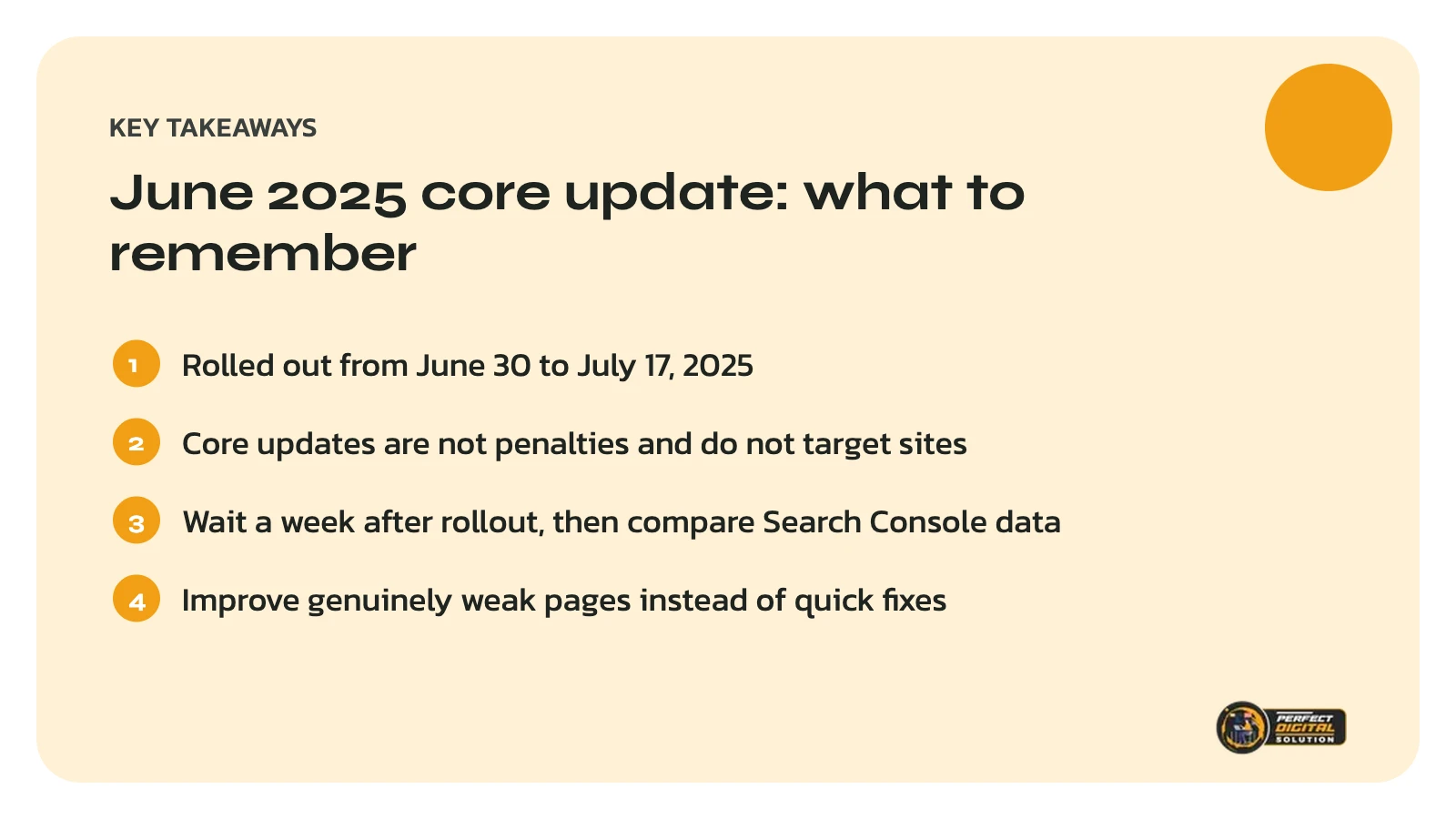
Quick answer: Google’s June 2025 core update started rolling out on June 30, 2025 and finished on July 17, 2025. Like every core update, it did not target individual sites. If your traffic changed, Google’s advice is to wait for the rollout to finish, compare data carefully and focus on genuinely helpful content rather than quick fixes.
Business owners often notice ranking swings during a core update and wonder whether they did something wrong. This guide explains what the June 2025 core update was, how to check whether it affected you and what a sensible response looks like.
What is a Google core update?
A core update is a broad change to Google’s ranking systems that happens several times a year. Google uses these updates to improve how it assesses content overall. They are not penalties, and they do not target specific websites or pages.
Before the June update, Google released the March 2025 core update, which ran from March 13 to March 27, 2025.
When did the June 2025 core update roll out?
The June 2025 core update began on June 30, 2025 and Google confirmed it was complete on July 17, 2025, a rollout of about two and a half weeks. Rankings can move up and down throughout a rollout, so daily changes during that period do not tell the full story.
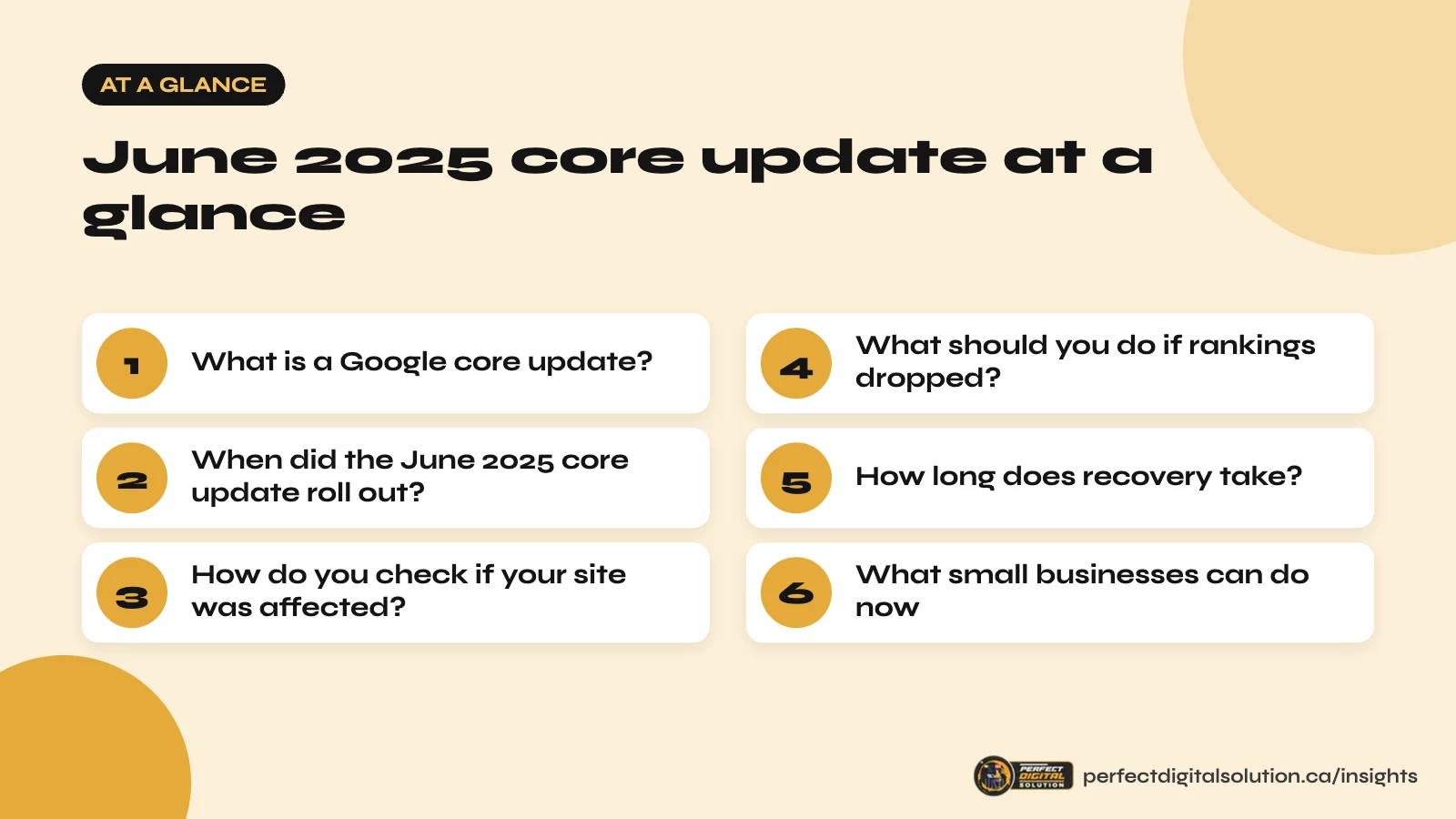
How do you check if your site was affected?
Use Google Search Console rather than a third-party rank tracker as your main source. Google suggests waiting at least a full week after an update has finished, then comparing that week with a week before the rollout started.
- Open the Performance report in Search Console.
- Compare a week after July 17 with a week before June 30.
- Look at clicks, impressions and average position by page and query.
- Check whether changes affect the whole site or only a few pages.
A small drop in position, for example from second to fourth, is common and does not call for drastic changes. Google specifically warns against changing pages that are already performing well.
What should you do if rankings dropped?
If you see a large, sustained drop across many pages, review your content honestly. Google recommends assessing pages against its helpful, reliable, people-first content questions, ideally with someone outside your business giving feedback.
- Does the page fully answer the question a visitor came with?
- Does it show first-hand experience or expertise?
- Is it accurate, up to date and clearly written?
- Would you trust it if you found it on another company’s site?
- Was it written mainly to rank, or mainly to help people?
Look at the pages that now rank above you. They may simply answer the query better. Improve your most affected pages first, and treat deleting content as a last resort for pages that cannot be saved.
Worried about a traffic drop? We can compare your Search Console data before and after the update and tell you whether action is needed. Get my free SEO audit.
How long does recovery take?
Recovery is rarely instant. Google says some changes can be reflected within days, but it can take several months for its systems to recognize lasting improvements. In some cases you may not see the effect until the next core update.
Google also notes that rankings change naturally all the time, and improving a site does not guarantee it will return to its previous position.
What small businesses can do now
The best protection against core update swings is a website built for people. For most small businesses, that means:
- A clear page for each main service, written in customers’ language.
- Real details: your process, service area, policies and genuine reviews.
- Fast, mobile-friendly pages with no broken links or technical errors.
- Regular updates to pages that answer common customer questions.
Our SEO services follow these principles, and our content marketing service helps you build helpful pages that hold up through updates.
Related reading: Google’s December 2025 Core Update: What to Do and What Not to Do, Technical SEO Audit Checklist: 20 Checks for Canadian Business Websites and How Long Does SEO Take to Work? Realistic Timelines for Canadian Businesses.
Frequently asked questions
Sources
- Google Search Central: Google Search’s core updates
- Google Search Central: Creating helpful, reliable, people-first content
- Google Search Status Dashboard
Written by the Perfect Digital Solution team. We use AI tools to support research and drafting, and every fact in this article is checked by our team against the sources listed above.